
Maritime Insights · Buyer's Guide
What Is the Best Crew Management Software? RiteCrew: Modern Maritime Crewing Software for a Flat Rate
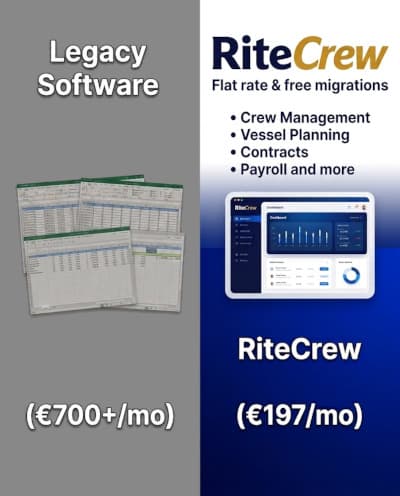 Per-vessel legacy pricing vs one flat rate. See the full breakdown.
I've spent the last ten years in crew management. First as a crewing officer juggling spreadsheets, later running crewing operations for a mixed fleet. In that time I've evaluated, implemented, or suffered through most of the crewing systems on the market.
So when someone asks me: what's the best crew management software? My answer is: it depends on your fleet size, your budget and how much pain you're willing to tolerate during rollout. But for small and mid-sized operators and crewing agencies, the answer has changed recently and I want to explain why.
The real problem: most crewing software is old and priced like it's 2007
Here's what nobody at the maritime software conferences says out loud: a huge share of the industry still runs crewing on tools that were designed before the iPhone existed.
I've seen it firsthand. A manning agency with 400 seafarers on its books tracking STCW certificates in an Excel file. An operator paying five figures a year for a desktop system that only works on one office computer, so crew changes stop when the crewing manager goes on leave. A superintendent finding out about an expired medical certificate from a port state control officer, not from his own system.
The software that does exist at the enterprise level has two problems for smaller operators.
It's built for fleets of 50+ vessels. The big systems assume you have a dedicated IT department, a six-month implementation budget and someone whose full-time job is system administration. If you run 3 to 15 vessels, you're buying a container ship to deliver a pizza.
It's priced per vessel. This is the part that quietly kills your margins. Most vendors charge per vessel, per user, or both. Add a vessel, your software bill goes up. Add a crewing officer, it goes up again. I've watched operators delay adding a fifth vessel to their management portfolio partly because of what it would do to their per-vessel software and admin costs. That's backwards.
So the real question isn't "what's the best crew management software" in the abstract. It's "what fits an operation my size without punishing me for growing."
RiteCrew: what it actually does
RiteCrew is a cloud-based crew management system built for exactly this gap: crewing agencies and vessel operators who need proper software but don't need (or want to pay for) an enterprise monolith. I'll walk through the four areas where it earns its keep.
Scheduling and rotations
Crew planning is where spreadsheets fail first. One changed relief date cascades into flight rebookings, visa timing and a master emailing you at 23:00 asking who his new chief engineer is.
RiteCrew handles shift changes, vessel rotations and long-term crew allocation in one planner. You see upcoming rotations across the whole fleet, who's due for relief, who's available and where the gaps are. Travel details and relief dates update in real time, so the office and the vessel work from the same live data instead of three versions of the truth. When I planned rotations manually, I kept a mental map of 60 seafarers' contract end dates. A planner that shows me that map and flags conflicts before they happen is worth more than any other single feature.
Compliance and certification
This is the feature that keeps you out of trouble. RiteCrew stores complete crew profiles: sea service records, STCW certificates, visas, medicals, flag state endorsements, training records. Every document has an expiry date and the system alerts you well before anything lapses.
If you've ever had a vessel held up because of one expired certificate, you know this isn't an administrative nicety. Under STCW and MLC, an invalid document is a deficiency and deficiencies mean observations, delays and in the worst case detention. Automated expiry tracking turns compliance from a monthly panic into a background process. When operators tell me they want marine software with crew management and STCW certification tracking capabilities, I simply open the dashboard: either everything is green, or they can see exactly what isn't and fix it weeks before the crew change instead of at the gangway.
Payroll and expenses
Maritime payroll is its own special discipline: contract-tied wage scales, allotments, sign-on and sign-off proration, overtime, leave pay. Doing it by hand means errors and payroll errors are how you lose good seafarers to a competitor paying the same wages but paying them correctly and on time.
RiteCrew ties pay directly to the contract. Wage scales are predefined or customized per rank and agreement, allotments go out in the right currencies and calculations follow the contract dates automatically. Contracts themselves are generated and versioned in the system, so the wage scale on the payslip always matches the wage scale the seafarer signed.
Mobile access
Crew changes don't happen during office hours. RiteCrew works from a phone, which means your crewing officer can check a certificate status from the airport and a seafarer can see his rotation and documents without emailing the office. It sounds small. It isn't. Half the phone calls a crewing department fields are people asking for information they could look up themselves if the system let them.
The pricing part
RiteCrew charges a flat rate. Plans start at €197 a month for crewing agencies, and vessel operators who need vessel planning and payroll pay a flat €397 a month - a 5-vessel operator pays the same as a 2-vessel operator. No per-vessel fees, no per-seat surprises.
When you win a new management contract, your software cost stays flat while the competition's bill goes up with every hull. For a growing agency, that difference compounds with every vessel you add. The full pricing is published, which is less common in this market than it should be.
Other crew management software worth knowing
No "best software" article is credible with only one product in it, so here are the established alternatives. These are serious products and for the right operator, the right choice.
ShipManager Crewing by DNV. Part of DNV's broader fleet management suite. Strong on fleet-wide planning, competency tracking and compliance workflows and it carries the credibility of a classification society behind it. Best suited to larger fleets already invested in the DNV ecosystem. Expect enterprise-grade implementation effort and enterprise-grade pricing to match.
SERTICA Crewing. SERTICA's strength is that crewing sits alongside technical operations and maintenance in one platform. If you want planned maintenance, procurement and crew administration under one roof, that integration is genuinely useful. The trade-off is that you're buying into a full suite; if you only need crewing, you're paying for scope you won't use.
COMPAS by OneOcean. A well-established crewing system that centralizes crew data, coordinates travel and gives seafarers self-service portals. It's been around a long time and it shows, in both good ways (deep functionality, mature workflows) and less good ones (the interface and deployment model feel like the era it came from).
So what's the best choice?
If you run 50 vessels with an IT department, look at DNV or SERTICA and budget accordingly. If you're already deep in the OneOcean ecosystem, COMPAS is a reasonable fit.
But if you're a crewing agency or an operator with a small-to-mid fleet, still running on spreadsheets or paying per-vessel fees for a system your team half-uses, that's the exact situation RiteCrew was built for. Modern cloud platform, the four functions crewing departments use every day (rotations, compliance, payroll, mobile) and one flat monthly price that doesn't grow when your fleet does.
After ten years of watching crewing departments fight their own software, my advice is simple: book a demo, bring your ugliest real-world crew change scenario and see how the system handles it. That test tells you more than any feature list, including this one.
Frequently asked questions
What is the best crew management software for a small fleet?
For operators running roughly 3 to 15 vessels, the deciding factor is usually pricing model rather than feature count. Enterprise systems from DNV or SERTICA assume a dedicated IT function and a long implementation. A flat-rate cloud platform such as RiteCrew covers the four daily functions - rotations, certificate compliance, payroll and mobile access - without per-vessel fees.
How much does crew management software cost?
Most vendors quote privately, per vessel or per named user, so two quotes for the same fleet rarely compare line by line. RiteCrew publishes flat rates: €197 a month on the Crewing Agency plan and €397 a month on the Vessel Operator plan, which adds vessel planning and payroll processing. Neither figure changes as the fleet grows.
Does crew management software handle STCW and MLC compliance?
A crewing system should store every certificate with its issue and expiry date and alert you before anything lapses, because under STCW and MLC an invalid document is a deficiency that can mean observations, delays or detention. RiteCrew tracks certificates against the requirements of each rank and flags an assignment when a required document is missing or expiring.
What's the best tool for managing crew records and certifications in the maritime sector?
Choose one system that keeps the seafarer record, the certificate register and the assignment history together, so the certificate check happens while you plan the crew change rather than in a separate spreadsheet afterwards. It should store the scanned document with its issue and expiry dates, know which certificates each rank needs under STCW and flag an assignment when something is missing or about to lapse. RiteCrew does exactly this at a flat monthly rate, and Crew Shield warns you weeks before a certificate expires.
Should a crewing agency use the same software as a vessel operator?
The needs differ. An agency supplies crew to other companies' vessels, so it needs a searchable pool, CV dispatch and vacancy posting. An operator runs the vessels and employs the crew aboard them, so it also needs vessel planning, rotation and payroll. RiteCrew splits its plans along that line rather than by fleet size.
How long does it take to migrate off spreadsheets?
Most operators are live within a week. The work is mostly cleaning the data rather than moving it: expect duplicate seafarer records, certificates recorded under three different names and contracts that exist only as Word files. That cleanup has to happen whichever system you end up on. RiteCrew includes free data migration on a contract of six months or more.
Bring your ugliest crew change scenario
In 20 minutes we will map your current crewing workflow into RiteCrew and show you exactly what changes - a rotation with a manning gap, a certificate matrix that has drifted out of date, a payroll month you are dreading. No slides, no qualification call.
Book a 20-minute demo, start a 60-day free trial with the migration done for you, or read the published pricing first. Free migration available · live in under a week · cancel anytime.
Published · Last updated